
Introduction
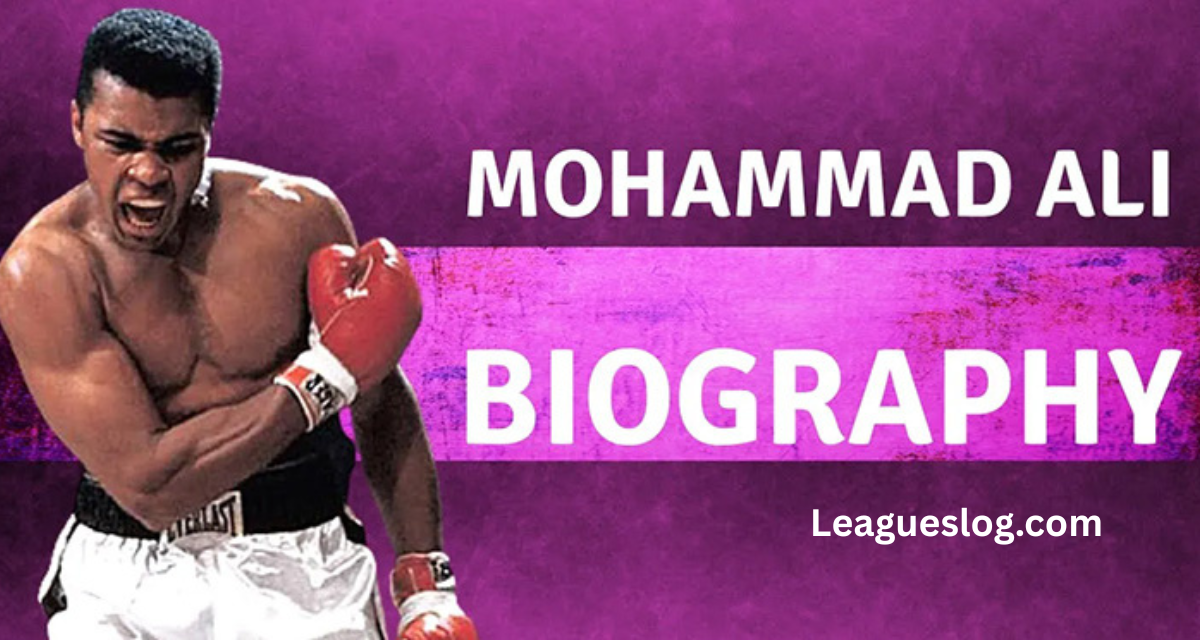
When we talk about boxing legends, one name echoes through every era — Muhammad Ali. Known for his unmatched speed, charisma, and courage both inside and outside the ring, Ali was more than a boxer; he was a symbol of resistance, freedom, and compassion. This Muhammad Ali biography dives deep into his early life, boxing career, personal struggles, social activism, and his everlasting impact on the world of sports and humanity.
Sports World Records 2025: Biggest Achievements of the Year
Early Life of Muhammad Ali
Born on January 17, 1942, in Louisville, Kentucky, as Cassius Marcellus Clay Jr., Muhammad Ali grew up in a segregated America where racial inequality was rampant. His father, Cassius Clay Sr., was a painter, and his mother, Odessa Clay, was a domestic worker.
At the age of 12, a stolen bicycle changed his life forever. Furious at the theft, young Cassius vowed to “whup” the thief, leading a police officer, Joe Martin, to introduce him to boxing. From that day, his passion was unstoppable.
Amateur Boxing Career
Muhammad Ali Biography talent shone early. He won six Kentucky Golden Gloves titles, two national titles, and the 1960 Olympic gold medal in Rome. His footwork and unique fighting style — keeping his hands low and moving swiftly — mesmerized spectators and confused opponents.
After winning Olympic gold, Ali turned professional, boasting confidence and charm that would soon make him the most famous athlete in the world.
Rise to Fame in Professional Boxing
Ali’s professional debut came on October 29, 1960, and he quickly built an impressive record. His mouth was as fast as his punches — he predicted the rounds he’d knock opponents out in, often delivering as promised.
By 1964, at just 22, Ali defeated Sonny Liston to become the World Heavyweight Champion. That fight changed boxing forever. His post-fight declaration, “I am the greatest!” became a timeless slogan of confidence and self-belief of Muhammad Ali Biography
Conversion to Islam and Name Change
Shortly after his championship victory, Ali announced his conversion to Islam and changed his name from Cassius Clay to Muhammad Ali, meaning “worthy of praise.” He joined the Nation of Islam, rejecting his “slave name” and embracing a new identity rooted in faith and pride.
This bold move shocked America during the 1960s — an era of racial tension and political unrest. Ali’s decision made him a cultural and spiritual leader, especially among oppressed communities worldwide.
Vietnam War Controversy and Ban
In 1967, at the height of his career, Muhammad Ali refused to be drafted into the U.S. Army, citing religious and moral objections. He famously said:
“I ain’t got no quarrel with them Viet Cong.”
His stand cost him dearly — he was stripped of his boxing titles, banned from the sport for over three years, and faced imprisonment.
Yet, this act of defiance transformed him into a global icon of resistance and peace, earning him respect far beyond the boxing world.
Comeback to Boxing
Ali’s return in 1970 marked one of the most celebrated comebacks in sports history. He fought against top contenders like Jerry Quarry, Joe Frazier, and George Foreman.
His fight against Joe Frazier in 1971, dubbed the “Fight of the Century,” was a brutal battle that Ali lost, but it cemented his legendary rivalry with Frazier.
Three years later, in 1974, he staged his greatest victory — the “Rumble in the Jungle” against George Foreman in Zaire.
Using his clever “rope-a-dope” strategy, Ali let Foreman tire himself out before knocking him out in the eighth round, reclaiming his title and shocking the world.
The Thrilla in Manila
In 1975, Ali faced Joe Frazier once more in the “Thrilla in Manila.” It was one of the most punishing fights in boxing history of Muhammad Ali Biography
After 14 grueling rounds, Frazier’s trainer stopped the fight, giving Ali the victory.
Ali called it “the closest thing to dying” he had ever experienced.
This fight epitomized Ali’s endurance, mental strength, and unbreakable will to win.
Later Years in Boxing
Ali continued to fight until 1981, winning 56 professional bouts and losing 5. His boxing style, a mix of power, agility, and psychology, revolutionized the sport.
However, the later part of his career was marked by physical decline, and by the early 1980s, he retired as a three-time World Heavyweight Champion — the only one to achieve that distinction at the time.
Battle with Parkinson’s Disease
In 1984, Ali was diagnosed with Parkinson’s disease, believed to be caused by years of head trauma. Despite his illness, he remained a public figure, advocating for peace, charity, and global unity.
His appearance at the 1996 Atlanta Olympics, where he lit the torch with trembling hands, moved the entire world. It became one of the most emotional moments in Olympic history.
International Boxing Hall of Fame
Humanitarian Work and Legacy
Beyond boxing, Muhammad Ali Biographydedicated his life to humanitarian causes. He worked with the United Nations, promoted peace during the Gulf War, and supported countless charities.
He received the Presidential Medal of Freedom in 2005 for his lifelong dedication to equality and humanitarianism.
Ali’s legacy extends beyond the ring — he became a symbol of confidence, compassion, and conviction.
Famous Quotes by Muhammad Ali
- “Float like a butterfly, sting like a bee.”
- “Service to others is the rent you pay for your room here on earth.”
- “Don’t count the days; make the days count.”
Each quote reveals his wisdom, humor, and human depth, making him one of the most quoted athletes in history.

Muhammad Ali’s Global Impact
Muhammad Ali Biography inspired not only athletes but generations of activists, artists, and thinkers.
He broke racial barriers, challenged political authority, and showed that sports could be a platform for change.
Even after his passing in 2016, his influence continues to shape discussions around race, justice, and the role of athletes in society.
Awards and Honors
- 3-time World Heavyweight Champion
- Olympic Gold Medalist (1960)
- Sports Illustrated’s “Sportsman of the Century”
- BBC’s “Sports Personality of the Century”
- Presidential Medal of Freedom (2005)
These honors reflect his dual greatness — as a fighter and as a humanitarian.
Conclusion
Muhammad Ali Biographylife was far more than a story of boxing victories; it was a narrative of courage, resilience, and unwavering conviction. From a young boy in Louisville to becoming a three-time World Heavyweight Champion, Ali consistently defied odds, challenged injustice, and inspired millions across the globe.
His refusal to fight in the Vietnam War, his fight against racial inequality, and his humanitarian efforts established him as both a sports icon and a global role model. Ali’s legacy demonstrates that greatness is not measured merely by titles and medals but by the impact one leaves on humanity. The Muhammad Ali biography continues to inspire athletes, activists, and everyday people to stand tall, fight for their beliefs, and live with purpose.
Frequently Asked Questions (FAQs)
1. Who was Muhammad Ali?
Muhammad Ali, born Cassius Marcellus Clay Jr., was an American professional boxer, three-time World Heavyweight Champion, and a global humanitarian icon.
2. When was Muhammad Ali born and when did he pass away?
He was born on January 17, 1942, and passed away on June 3, 2016.
3. What are Muhammad Ali’s major achievements?
Ali won three World Heavyweight titles, an Olympic gold medal in 1960, and received accolades like Sportsman of the Century and the Presidential Medal of Freedom.
4. Why did Muhammad Ali change his name?
He converted to Islam and changed his name from Cassius Clay to Muhammad Ali, rejecting his former “slave name” and embracing a new identity of faith and pride.
5. What made Muhammad Ali a controversial figure?
Ali was controversial for refusing the Vietnam War draft, speaking out against racial injustice, and his outspoken personality, which challenged norms in 1960s America.
6. What was Muhammad Ali’s fighting style?
Ali was known for his speed, agility, and psychological tactics, famously described as “float like a butterfly, sting like a bee.”
7. Did Muhammad Ali face any health issues?
Yes, he was diagnosed with Parkinson’s disease in 1984, which affected him for the rest of his life.
8. What is Muhammad Ali’s legacy?
Ali’s legacy extends beyond boxing. He is remembered as a symbol of courage, social activism, and humanitarianism, inspiring generations worldwide.
9. Are there books or movies about Muhammad Ali?
Yes, his life has been depicted in multiple biographies and films, including “Muhammad Ali: The Greatest”, documentaries, and books chronicling his boxing career and humanitarian efforts.
10. Why is Muhammad Ali considered the greatest?
He is considered the greatest not only for his boxing skill but for his charisma, courage, activism, and influence on global culture, making him a legend inside and outside the ring.
Paris 2024 Olympics Aftermath: Records, Controversies and What’s Next