

The use of technology in sports has grown rapidly over the last decade, and cricket is no exception. Among the most impactful innovations is AI in cricket, particularly in umpiring and decision review systems. Artificial intelligence has transformed how decisions are made on the field, reducing human error, increasing transparency, and improving fairness in the game.
From ball-tracking systems to edge detection and real-time analytics, AI in cricket has become an essential component of modern officiating. The evolution of umpiring technology has not only enhanced decision accuracy but has also reshaped how players, umpires, and fans experience the sport.
Hawk Eye Accuracy in Cricket: Is the Game Still Fair?
Understanding AI in Umpiring
AI in Cricket umpiring refers to the use of artificial intelligence, machine learning algorithms, and advanced sensor technology to assist umpires in making accurate decisions. These systems analyze large volumes of real-time data, including ball trajectory, sound waves, player movement, and impact angles.
Unlike traditional methods that rely solely on human judgment, AI in cricket introduces data-driven decision-making, offering objective insights that help officials review complex scenarios with precision.
Evolution of Decision Review Systems in Cricket
Before the introduction of advanced technology, umpiring decisions were final and often controversial. The introduction of the Decision Review System (DRS) marked a turning point in international cricket.
Over time, AI in Cricket has played a crucial role in refining DRS by:
- Improving ball-tracking accuracy
- Enhancing sound-based edge detection
- Providing predictive models for LBW decisions
- Reducing review processing time
Today, DRS is a sophisticated blend of human expertise and artificial intelligence.
More details on DRS technology can be found at:
https://www.icc-cricket.com/about/cricket/rules-and-regulations/decision-review-system
AI in Ball-Tracking Technology
Ball-tracking is one of the most visible applications of AI . Systems such as Hawk-Eye use multiple high-speed cameras placed around the ground to track the ball’s movement from release to impact.
Artificial intelligence algorithms process this data to:
- Predict the future trajectory of the ball
- Determine whether the ball would hit the stumps
- Assist LBW decisions with high accuracy
By analyzing thousands of previous deliveries, AI in ball-tracking systems continuously improve their predictive capabilities.
Learn more about Hawk-Eye technology:
https://www.hawkeyeinnovations.com
Role of AI in Edge Detection
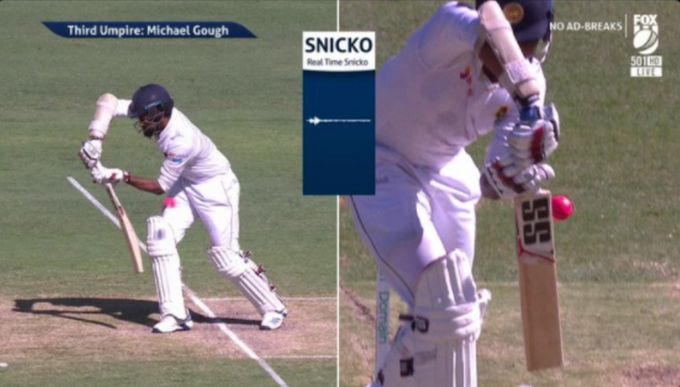
Another critical aspect of umpiring decisions involves determining whether the bat made contact with the ball. AI-powered edge detection tools such as UltraEdge and Snickometer analyze sound frequencies and visual data.
AI in cricket edge detection works by:
- Capturing high-frequency audio signals
- Filtering background noise
- Identifying unique sound patterns of bat-ball contact
Machine learning models are trained to distinguish between bat edges, pad impacts, and ambient noise, ensuring accurate reviews during contentious moments.
AI in Cricket for LBW Decision Accuracy
Leg Before Wicket (LBW) decisions are among the most complex in cricket. AI has significantly enhanced LBW accuracy by combining ball-tracking, pitch mapping, and historical data.
AI algorithms calculate:
- Pitching point of the ball
- Impact location on the pad
- Projected path toward the stumps
This data-driven approach minimizes guesswork and provides umpires with consistent and reliable decision support.
Impact of AI in Cricket on On-Field Umpires
The integration of AI in cricket does not replace umpires but supports them. On-field officials remain responsible for initial decisions, while AI systems act as a review mechanism.
Key benefits for umpires include:
- Reduced pressure during high-stakes moments
- Improved confidence in decision-making
- Faster access to accurate data
By assisting rather than replacing human judgment, AI in cricket umpiring maintains the traditional spirit of the game while enhancing fairness.
AI in Cricket and Third Umpire Decision-Making
Third umpires play a crucial role in reviewing decisions using technology. AI has streamlined the review process by providing real-time data visualization and automated alerts.
Advanced AI interfaces allow third umpires to:
- Review multiple camera angles instantly
- Access synchronized audio-visual data
- Make faster, more accurate rulings
This efficiency ensures minimal disruption to match flow.
AI in Cricket and Real-Time Data Processing
One of the most powerful aspects of AI is its ability to process data in real time. Modern systems analyze millions of data points per second, delivering instant insights to match officials.
Real-time AI processing enables:
- Immediate review availability
- Faster overturning or confirmation of decisions
- Improved viewer engagement through live graphics
This technological advancement has elevated the overall viewing experience for fans.
Transparency and Fairness Through AI in Cricket
Transparency is a key benefit of AI . Decision-making supported by AI reduces controversies by providing clear visual evidence and data explanations.
Broadcasters now display:
- Ball trajectory graphics
- Impact zones
- Edge detection visuals
These insights help fans understand decisions, increasing trust in the officiating process.
AI in Cricket Across Different Formats
The application of AI in Cricket spans all formats of the game, including:
- Test cricket
- One Day Internationals
- T20 and franchise leagues
Shorter formats, where decisions can significantly impact outcomes, benefit greatly from AI-assisted umpiring due to the fast pace of play.
Role of AI in Cricket Leagues and Tournaments
Major cricket boards and leagues have embraced AI in Cricket to maintain global officiating standards. Tournaments such as the ICC World Cup, IPL, and international series rely heavily on AI-powered review systems.
International Cricket Council updates on technology use:
https://www.icc-cricket.com
These technologies ensure consistency across venues and conditions worldwide.
Challenges of AI in Cricket Umpiring
Despite its advantages, AI in Cricket faces challenges:
- Dependence on camera quality and placement
- Environmental factors affecting sensors
- Interpretation of marginal calls
Human oversight remains essential to address these limitations and maintain balance between technology and tradition.
Ethical Considerations of AI in Cricket Decisions
The growing reliance on AI in Cricket raises ethical questions regarding data ownership, system bias, and decision accountability. Cricket authorities continuously review technology protocols to ensure fairness and transparency.
Maintaining public trust requires:
- Regular system audits
- Clear communication of AI limitations
- Balanced integration with human judgment
Future Advancements of AI in Cricket Umpiring
The future of AI in Cricket is expected to include:
- Fully automated no-ball detection
- Enhanced player tracking for obstruction decisions
- AI-assisted off-field conduct reviews
As machine learning models evolve, umpiring accuracy and efficiency are likely to improve further.
AI in Cricket and Fan Engagement
Beyond umpiring, AI in Cricket enhances fan engagement by offering deeper insights into match events. Real-time analytics, decision breakdowns, and interactive graphics keep audiences informed and engaged.
Technology providers continue to innovate ways to bring AI-powered storytelling into cricket broadcasts.
Global Acceptance of AI in Cricket
Cricket boards, players, and fans have largely accepted AI in Cricket as a necessary evolution. While debates continue over marginal decisions, the overall impact has been positive in improving match integrity.
AI-assisted systems are now considered an essential part of international cricket infrastructure.
Training and Calibration of AI Systems in Cricket
AI systems used in cricket undergo extensive calibration and testing. AI in Cricket relies on historical match data, simulated scenarios, and live testing to maintain accuracy.
Regular updates ensure:
- Adaptation to different pitch conditions
- Improved prediction models
- Reduced system errors
Conclusion
The growing use of AI in Cricket has fundamentally transformed umpiring and decision review systems, bringing greater accuracy, consistency, and transparency to the game. By integrating ball-tracking, edge detection, and real-time data analysis, artificial intelligence has significantly reduced human error while supporting umpires in high-pressure situations. These advancements have strengthened trust among players, officials, and fans alike.
As cricket continues to evolve, AI in Cricket is expected to play an even more influential role in officiating. While human judgment remains central to the sport, the partnership between umpires and AI technology ensures that decisions are fair, data-driven, and aligned with the modern demands of international cricket.
Mirabai Chanu Biography: Lifting India’s Pride to New Heights
FAQs
1. What is AI in Cricket umpiring?
AI in Cricket umpiring refers to the use of artificial intelligence and machine learning technologies to assist umpires in making accurate decisions through tools like ball-tracking, edge detection, and data analytics.
2. How does AI help in the Decision Review System (DRS)?
AI enhances the Decision Review System by analyzing ball trajectory, sound waves, and impact points to provide objective data that helps confirm or overturn on-field decisions.
3. Is AI in Cricket completely replacing human umpires?
No, AI in Cricket does not replace umpires. It supports officials by offering data-based insights while final decisions still involve human judgment and interpretation.
4. How accurate is AI in Cricket ball-tracking technology?
Ball-tracking systems powered by AI are highly accurate, using multiple camera angles and predictive algorithms to estimate the ball’s path with a very small margin of error.
5. What are the main benefits of AI in Cricket officiating?
The main benefits include improved decision accuracy, reduced controversies, faster reviews, greater transparency, and increased confidence in umpiring decisions.
6. Are all international cricket matches using AI-based umpiring systems?
Most major international matches and tournaments use AI-assisted systems, though availability may vary depending on infrastructure and tournament regulations.
7. What challenges does AI in Cricket face?
Challenges include dependence on camera quality, environmental factors, interpretation of marginal decisions, and the need for continuous system calibration.
8. What is the future of AI in Cricket umpiring?
The future of AI in Cricket may include automated no-ball detection, enhanced player tracking, and more advanced real-time decision support systems.
Kaleemullah Khan Biography: The Trailblazer Who Put Pakistani Football on the Map