
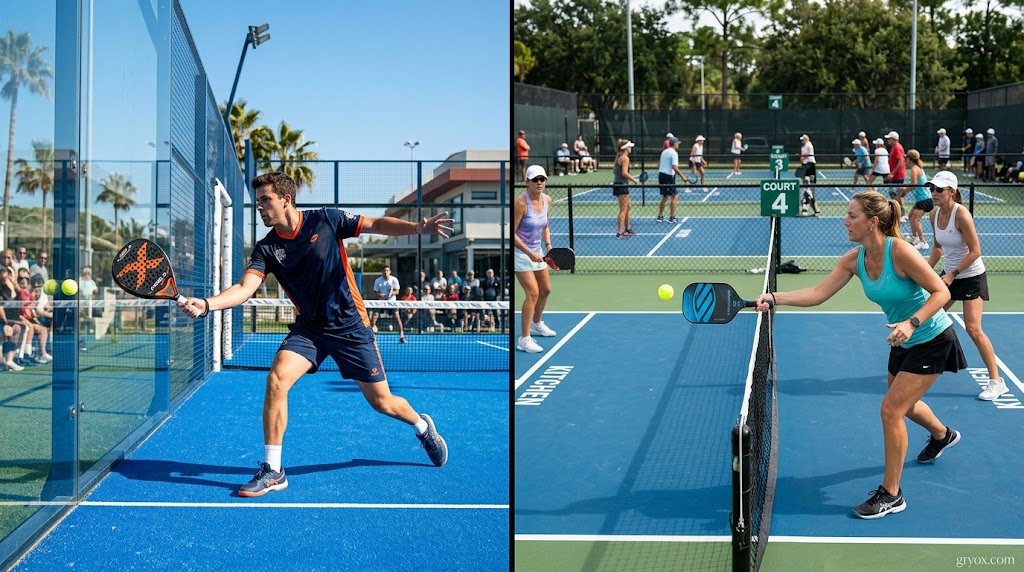
Racket sports are undergoing a massive global renaissance. If you have spent any time at your local park, leisure center, or private sports club recently, you have likely heard the distinct, sharp soundscape of modern athletics: the high-pitched pop of a polymer paddle striking a plastic ball or the heavy, deep thud of a pressurized padel ball bouncing off a reinforced tempered glass enclosure. Two fast-growing, highly dynamic sports are currently fighting for the hearts, minds, and weekends of active adults across the Western world: pickleball and padel.
Both disciplines have exploded in popularity across the United Kingdom, the United States, continental Europe, and Australia. They bridge the generational gap between casual recreational fun and intense, highly tactical competition. Yet, beneath their shared reputation as social, highly accessible racket games, pickleball and padel are entirely different beasts. They feature distinct court dimensions, specialized gear, contrasting structural rules, drastically different physical movement patterns, and unique cultural vibes.
Whether you are looking to pick up a new health hobby, convert underutilized tennis facilities, invest in club infrastructure, or simply understand what everyone at the local clubhouse is talking about, this comprehensive, highly detailed guide breaks down everything you need to know about pickleball vs padel equipment, court engineering, strategic mechanics, gear differences, and why these two racket sports are capturing the cultural zeitgeist in North America and Europe.
1. The Racket Sport Revolution: Macro Trends in the UK, USA, and Beyond
Before diving into the complex technical differences, it helps to understand why millions of players across North America and Europe are migrating away from traditional tennis courts in favor of these compact, high-velocity alternatives.
The Decline of Traditional Tennis Monopoly
For over a century, lawn tennis reigned supreme as the undisputed king of racket sports. However, tennis possesses an exceptionally steep, often punishing learning curve. Mastering a reliable service stroke, generating topspin, and covering a massive baseline requires years of dedicated coaching, physical conditioning, and repetitive practice. Beginners often spend more time picking up stray balls from fences than engaging in exhilarating rallies.
By contrast, both pickleball and padel were intentionally engineered for immediate gratification. They minimize the technical frustration loop without sacrificing long-term strategic depth.
The Low Barrier to Entry and Rapid Skill Acquisition
Pickleball features a scaled-down court surface and a lightweight, slow-moving, perforated plastic ball. This setup means that sustained, exciting rallies happen within the first ten minutes of play. Beginners can execute meaningful strategic shots almost instantly.
Padel introduces solid enclosure walls that keep the ball inside the field of play much longer than a traditional mesh tennis fence. This dramatically reduces wasted time spent chasing errant shots and transforms chaotic missed hits into strategic wall rebounds. You do not need an extensive background in elite varsity athletics to enjoy a vigorous, competitive match on day one.
The Social Dynamics: Community, Rotations, and Culture
Both sports are inherently social ecosystems. Pickleball courts are remarkably space-efficient; urban planners can fit four fully functional pickleball courts within the physical footprint of a single traditional tennis court. This creates a bustling, stadium-like atmosphere where 16 players can interact, rotate in and out of games, chat between sets, and build vibrant local communities.
Padel, almost exclusively played as doubles within an intimate 10×20 meter glass box, demands constant vocal communication, tactical trust, and teamwork. The proximity of players fosters intense post-match camaraderie, giving rise to ‘padel cultures’ complete with clubhouse lounges, coffee bars, and lifestyle apparel brands.
2. Pickleball Deep Dive: Engineering, Mechanics, and Gear Anatomy
To fully appreciate the nuances of pickleball vs padel equipment, we must carefully examine the structural anatomy of the pickleball game environment. Invented in the summer of 1965 on Bainbridge Island, Washington, by Joel Pritchard, Bill Bell, and Barney McCallum, pickleball evolved from an improvised backyard family game into an international multi-million-dollar phenomenon.
Court Dimensions, Markings, and Net Physics
A standard official pickleball court measures 20 feet (6.10 m) wide by 44 feet (13.41 m) long for both singles and doubles play. The boundary lines are identical to a double-badminton court layout. The net spans across the center, standing at 36 inches (91.4 cm) high at the outer sidelines and drooping slightly to 34 inches (86.4 cm) at the exact midpoint.
The Non-Volley Zone (‘The Kitchen’)
The defining anatomical feature of a pickleball court is the non-volley zone, universally referred to as ‘the kitchen.’ This is a rectangular 7-foot-deep (2.13 m) area extending from the net on both sides across the full width of the court.
- Kitchen Rules: Players are strictly prohibited from hitting the ball out of the air (volleying) while standing inside the kitchen or touching any kitchen boundary line with their feet, clothes, or paddle.
- Tactical Purpose: The kitchen single-handedly neutralizes powerful, point-ending overhead smashes right at the net. It forces players into a delicate, highly strategic soft game known as ‘dinking,’ where precision, patience, and placement supersede brute physical power.
Essential Pickleball Equipment Breakdown
- 1. The Pickleball Paddle: Unlike traditional tennis or squash rackets that use strung frames, a pickleball paddle features a solid, unstrung face. Modern high-performance paddles weigh between 7.0 and 8.5 ounces and consist of three main layers: polymer honeycomb cores, carbon fiber or fiberglass facings, and edge guards.
- Paddle Core Options: Made from polymer honeycomb, aluminum, or Nomex. Polymer honeycomb is the industry standard because it absorbs shock while providing a plush, controllable feel.
- Paddle Facing Materials: Raw carbon fiber (T700) provides incredible friction for generating heavy topspin, while fiberglass offers maximum pop and power for aggressive hitters.
- 2. The Pickleball Ball: Outdoor balls feature 40 small, machine-drilled holes for wind resistance. Indoor balls feature 26 larger, softer holes for smooth indoor play.
- 3. Footwear and Gear: Dedicated court shoes with non-marking rubber outsoles and strong lateral support are mandatory to prevent ankle rollovers during quick dashes to the kitchen line.
Core Rules of Pickleball Play
- 1. Underhand Serve Requirement: Serves must be delivered underhand with an upward arc. The paddle contact point must be below the waistline, and the paddle head must not reside above the wrist joint at impact.
- 2. The Two-Bounce Rule: Following the serve, the receiving team must allow the ball to bounce once before returning it. Subsequently, the serving team must also let the returned ball bounce once before striking it.
- 3. Side-Out Scoring: Points can only be accumulated by the side serving the ball. Games are typically played to 11 or 15 points, and a team must win by a 2-point margin.
3. Padel Deep Dive: Glass Engineering, Wall Dynamics, and Bat Mechanics
Now, let us cross the Atlantic and examine the mechanics of padel. Invented in Acapulco, Mexico, in 1969 by businessman Enrique Corcuera, padel gained widespread popularity in Spain, Argentina, and South America before exploding across Northern Europe, the UK, and metropolitan regions of the United States.
Court Architecture, Glass Walls, and Mesh Fencing
A padel court is an enclosed box measuring 10 meters (32 feet, 10 inches) wide by 20 meters (65 feet, 7 inches) long. It is roughly one-third the size of a standard tennis court. The court structure combines high-strength tempered glass panels at the back walls and sides with structural steel mesh fencing along the mid-court sections.
The Wall Bounce Mechanics
The structural walls are active playing elements in padel, functioning similarly to squash or racquetball:
- Tempered Glass Panels: Positioned at the back and rear sides (up to 3 or 4 meters high). Glass produces a uniform, predictable bounce, allowing players to play off the glass and hit dramatic recovery shots.
- Metallic Mesh Wire: Positioned along the side walls near the net. Bouncing off the metallic mesh generates unpredictable, chaotic trajectories, making defensive play much harder.
Essential Padel Equipment Breakdown
- 1. The Padel Racket (Bat): Padel bats do not have strings. Instead, they are solid composite bats built with an internal EVA foam or Polyethylene core wrapped in layers of fiberglass or carbon fiber. They feature drilled hole patterns for aerodynamic efficiency.
- Racket Shapes: Round shape (control/low balance), Teardrop shape (balanced power and control), and Diamond shape (maximum power for advanced smashes).
- Mandatory Safety Strap: By international regulations (FIP), every padel racket must feature a non-removable safety wrist strap that players must attach during play.
- 2. The Padel Ball: Padel balls resemble tennis balls but are manufactured with lower internal pressure (11 to 14 psi) to keep bounces manageable within glass enclosures.
- 3. Footwear and Surfaces: Courts feature artificial turf carpets dusted with fine silica sand. Players require full herringbone or omni-court tread shoes for proper traction and sliding stability.
Core Rules of Padel Play
- 1. Underhand Bounce Serve: All serves must be performed underhand after bouncing the ball once behind the service line, striking it at or below waist level diagonally into the opponent’s service box.
- 2. Tennis Scoring Mechanics: Padel utilizes standard tennis scoring (15, 30, 40, Game, Sets). Matches are usually decided in a best-of-three set format.
- 3. Wall Interaction Rules: A returned ball must strike the opponent’s turf surface before touching any rear glass wall or mesh fence. Once bounced on turf, it can bounce off walls, and players can hit balls off their own back glass wall!
4. In-Depth Head-to-Head Comparison: Pickleball vs Padel
To help recreational enthusiasts, venue developers, and athletes decide which sport aligns best with their goals, let us evaluate both disciplines across a comprehensive feature matrix.
| Feature Category | Pickleball | Padel |
| Country of Origin | United States (1965) | Mexico (1969) |
| Court Footprint | 20 x 44 feet (6.1 x 13.4 m) | 10 x 20 meters (Enclosed) |
| Boundary System | Open boundary court lines | Tempered glass & wire mesh |
| Racket Material | Polymer core + Carbon face | EVA Foam + Carbon shell |
| Racket Weight | 7.0 to 8.5 ounces (200-240g) | 12.3 to 13.7 ounces (350-390g) |
| Ball Composition | Perforated hard polymer plastic | Pressurized rubber felt ball |
| Scoring Convention | To 11 or 15 (Points on serve) | Standard Tennis (15-30-40) |
| Dominant Play Format | Doubles & Singles | Strictly Doubles |
| Avg. Caloric Burn | 400 – 600 kcal/hour | 600 – 850 kcal/hour |
| Equipment Costs | Low ($30 – $220 entry) | Moderate ($80 – $350 entry) |
Physical Demands, Biomechanics, and Injury Prevention
- Pickleball Physical Profile: Pickleball emphasizes hand-eye speed, fast reflex volleys, and delicate soft-touch accuracy over long-distance running. It offers low to moderate aerobic load with minimal shoulder stress, though proper footwear is vital for quick kitchen-line adjustments.
- Padel Physical Profile: Padel demands multi-directional agility, rotational core strength, and physical endurance. Continuous play off rear walls removes dead time between shots, yielding high aerobic burn. Heavier rackets require proper wrist and shoulder warm-ups.
5. Cultural Explosion: Adoption Patterns Across UK & USA
The meteoric rise of pickleball and padel reflects broader shifts in how Western cultures approach fitness, social networking, and urban leisure space allocation.
The American Pickleball Phenomenon
In North America, pickleball has achieved extraordinary cultural saturation. Driven by municipal tennis court conversions, celebrity team owners (such as LeBron James and Tom Brady), and entertainment venue concepts like Chicken N Pickle, public parks across all 50 states are continuously retrofitting courts to meet surging player demand.
The European and British Padel Expansion
In the UK, Sweden, Italy, Spain, and Northern Europe, padel has firmly established itself as the premier premium racket sport. Backed by sporting legends like Andy Murray and Zlatan Ibrahimović, major indoor padel clubs featuring lounges and espresso bars are opening across London, Manchester, and European metropolitan centers.
6. Strategic Gameplay Tactics: How to Win in Both Sports
While both sports appear simple to pick up, mastering competitive matches requires completely different tactical skill sets.
Winning Tactics in Pickleball
- 1. Race to the Kitchen Line: The primary goal in pickleball doubles is to move forward to the kitchen line as a synchronized unit to dominate court angles and strike downward volleys.
- 2. Master the Third-Shot Drop: Striking a delicate, arching ‘third-shot drop’ that lands softly inside the opponent’s kitchen prevents aggressive volleys, allowing the serving team to advance.
- 3. Patience in Dinking Battles: Soft dinking exchanges demand patience. The player who loses patience and lifts the ball above net height grants opponents an easy overhead smash opportunity.
Winning Tactics in Padel
- 1. Claiming Net Position: Padel players strive to dominate the net area as close as legally possible to unleash aggressive, point-ending volleys and smashes.
- 2. Using Lobs to Reset: When pushed to the back glass wall, hitting a high, deep lob over the opponents’ heads forces them to abandon the net and sprint backward.
- 3. Exploiting Wall Trajectories (Bandeja): The Bandeja (tray shot) is a unique flat slice overhead hit before the ball reaches the glass wall, keeping net position without risking an over-committed smash.
7. Frequently Asked Questions (FAQs)
Can you use a tennis racket to play padel or pickleball?
No. Neither sport permits traditional strung tennis rackets. Pickleball requires a specialized flat composite polymer paddle, while padel demands a solid, perforated composite bat with an internal foam core. Using a tennis racket would violate equipment rules and fail completely due to court and ball dynamics.
Which sport is easier for complete beginners to learn?
Pickleball has the gentlest learning curve overall. The slow-moving plastic ball and smaller, open court layout allow complete beginners to sustain fun, competitive rallies within their first session. Padel is also easy to pick up, but mastering wall rebounds requires a slight adjustment period.
Is padel or pickleball more expensive to play?
Pickleball is generally more budget-friendly. Entry-level paddles cost $30 to $60, plastic balls are inexpensive, and thousands of public concrete courts are free to access across the USA and UK. Padel usually involves booking indoor or semi-covered glass court facilities, which incur hourly court rental fees split among four players.
Can pickleball be played outdoors in rainy or windy climates?
While outdoor pickleball is widely played on sunny days, wind can alter the flight path of the lightweight plastic ball, and wet courts can cause slippage. Many clubs in rainy regions like the UK and Pacific Northwest USA use indoor sports courts or converted warehouse spaces for year-round play.
Which sport offers a better cardiovascular workout?
While both provide great aerobic exercise, padel generally yields higher caloric expenditure per hour. The combination of larger court coverage, continuous rallies off glass walls, and explosive lateral leaps results in a continuous, high-intensity workout compared to casual recreational pickleball.
What footwear is best for padel vs pickleball?
Pickleball requires outdoor non-marking tennis court shoes with durable lateral rubber soles. Padel requires specialized padel footwear featuring full herringbone (zig-zag) or omni-court tread patterns designed specifically to grip artificial turf carpets coated with fine silica sand.
8. Final Verdict: Which Racket Sport Should You Choose?
The current explosion of alternative racket sports marks a permanent shift in modern athletic culture. Neither pickleball nor padel is a passing trend—both are established global sports with thriving communities, growing professional circuits, and passionate player bases.
- Choose Pickleball if you want: A highly accessible, budget-friendly sport with an instant learning curve, easy public court access, minimal joint strain, and a vibrant, friendly social scene.
- Choose Padel if you want: A high-energy, tactical sport that combines tennis volleys with squash-style wall bounces, intense athletic conditioning, dynamic team rallies, and a modern indoor club lifestyle.
Whichever path you choose, understanding pickleball vs padel equipment, court dimensions, and game rules will help you hit the court with confidence. Grab your paddle or bat, rally your friends, and enjoy the exciting world of modern racket sports!
If you are looking to explore upcoming major international tournaments and fixtures, make sure to check out our detailed guide on the ICC Cricket World Cup 2027 Schedule.